
Turns out, 2025 marks 160 years since the publication of Lewis Carroll’s ‘Alice’s Adventures in Wonderland’. The story behind the book and its publication is detailed and complex.
Alice Pleasance Liddell (1852 – 1934) was four years old when she first met the mathematician, Charles Lutwidge Dodgson (Lewis Carroll’s real name). She lived at Christ Church College at the University of Oxford, where her father was the Dean and Dodgson was a maths tutor. Dodgson’s study adjoined the Liddells’ lodgings and he soon became friend, photographer, and storyteller to the Liddell family. A story he had told young Alice and her sisters, Lorina and Edith, on a boat outing, formed the basis of the Alice stories. Usually, after Dodgson had told them stories, they would vanish in the air as quickly as he’d had invented them. However, Alice Liddell must have liked these particular tale very much, because she had asked Dodgson to it down for her. He was hesitant at first, but then gave in and stayed up late that night to jot down the main events. He sketched an initial outline of the story on the train the next day. Dodgson started to write the full text on November 13, 1862 and it would be completed by the end of February, 1863. Once the story was finished, he would copy it out again, meticulously, in a script that Alice could easily read, with spaces left for his own drawings.
Dodgson was not a trained artist, but took great care to produce the best artwork he could, so before he first created several sketches. Sheets of these preliminary drawings survive. There are pictures of guinea pigs, a lizard, a flamingo, rabbits, a mole, a puppy, various fish, a seahorse, a mouse, and a caterpillar. Two imaginary creatures, a gryphon and a mock-turtle, are beautifully drawn, but are signed with the initials ‘W.L.D.’ which indicates these were done by his brother, Wilfred Longley Dodgson. There are various drawings of the fictional Alice. Also drawn are the heads of elves, goblins and other mythical creatures that do not appear in the final version of the story. These are thought to be from the stories Dodgson told the Liddell children on the boat trip, but are ones he chose not to include in the final version of the manuscript. It took him a while to complete his pictures. He finished them on September 13, 1864, the manuscript complete. That identified, on or around January 25th, 1864, Dodgson had approached Sir John Tenniel to draw the illustrations for his book and provided him with detailed instructions of how to draw them. Tenniel’s agreement to do the artwork was secured on April 5, 1864 and he would then create 42 wood-engraved illustrations. Dodgson retained the manuscript version for reference as he expanded the book into ‘Alice’s Adventures in Wonderland’. He presented ‘Alice’s Adventures Under Ground’ in a leather booklet, to Alice as a Christmas gift, on November 26, 1864.
It is not known how long exactly Dodgson took to finish ‘Alice’, but it was first printed on July 4, 1865, exactly 3 years after the boat trip. Published by Macmillan and Co., London, it was set in print by the Clarendon Press at Oxford University Press and bound by James Burn & Co. from London. This first edition consisted of 2,000 printings, but because Tenniel was dissatisfied with the quality of the pictures as they were printed (ink bleed on the pages, widowed lines, and the use of mixed fonts), all 50 presentation copies that had been bound by that time, were recalled within a month. The edges were plain, as per Dodgson’s request. All but about 23 copies of the originals were fetched back and donated to children’s hospitals and the like. There are only 22 (some sources cite 21, others 23) extant copies of this edition known to date and all but five are in public institutions.
In the second attempt, another 2,000 copies were produced. A new printer (Richard Clay of Bungay) had been acquired. The paper used was finer in quality and the typesetting superior to the first publication. This new ‘first edition’ was issued on November 18, 1865 (though dated 1866). This said, the date of November 26 is often, even usually, cited instead. These copies, for the most part, have light blue, sometimes dark green, end papers. The new first edition did have gilded edges, as had Macmillan advised Dodgson to adopt this detail. It sold for 7 shillings and 6 pence (7s 6d), a large sum back then with the approximate equivalent in purchasing power today of $70CDN to $150CDN (if I’ve calculated things correctly). I read that 125 copies of these were given away.
Initial sales of the book were good, with 500 copies sold by November 30. Still, Dodgson was disappointed in the number and expressed this is a letter to Macmillan in March, 1866. Macmillan had assured him that sales would pick up, that there was no need for adverts and they were quite right, as we all know. I read that as of June 30, 1866, 1362 copies had been sold. Lesser known is that the whole publication process had been financed by Dodgson. He paid for the paper, the illustrations, the engraving of the illustrations, the binding, and everything else. Macmillan had published it under commission and received 10% for advertising and distribution. Dodgson scrutinized all editions of the book and was known to often complain about the printing, pictures, and typesetting, clearly more concerned about the quality of his book than the profit made.
The earliest (Alice’s Adventures Under Ground’) version did not include ‘The Caucus Race’, ‘Pig and Pepper’ and ‘A Mad Tea-Party’. The Cheshire Cat had not yet been created. The Ugly Duchess was called ‘the Marchioness of Mock Turtles’, the part of the Mock Turtle’s schooldays was absent, and the greater part of the Trial scenes was written in later. The ‘Mouse Tale’ was different in the original and the title obviously changed. Dodgson had explained in a letter to a friend that he feared ‘Alice’s Adventures Under Ground’ sounded like a book that contained ‘instruction about mines’ and suggested: ‘Alice among the elves / goblins’ or ‘Alice’s hour / doings / adventures in elf-land / wonderland’. He personally preferred ‘Alice’s Adventures in Wonderland’, so this was the final title.
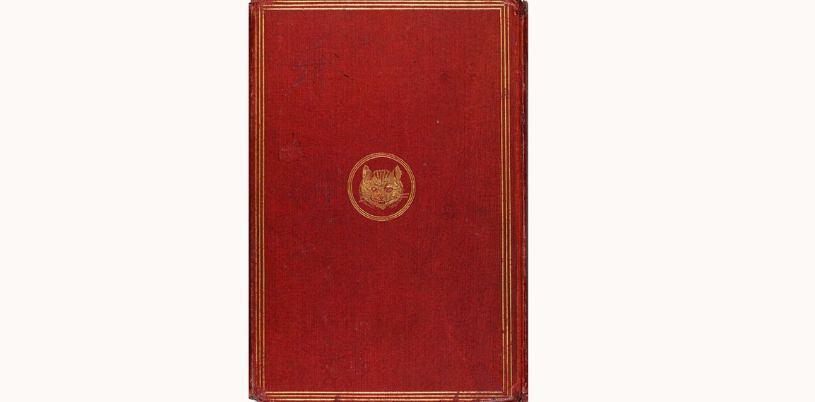
Concerned about how his book would look, Dodgson discussed the options with his publisher. On June 21, 1864 he’d visited Macmillan. They advised him to alter the size of the page, and to choose a size similar to that of the ‘Water Babies’ by Charles Kingsley, so larger than planned. Carroll discussed this with Tenniel, and they both agreed. He chose bright red as the colour for the cover and as said, the very first edition did not have gilt edges. Dodgson was not only particular about the printing and aesthetic presentation of his book, he also kept a tight reign on how Macmillan promoted it. He wanted to be kept informed about sales and had tried to influence its pricing more than once. He considered different formats, like an inexpensive edition for middle class children. The book, an immediate success, soon had a second edition printed, in two print runs of 2,000 each in September 1866 that were published in November. I learned that 5,000 copies had been sold by the end of the year. The third edition appeared in 1867, also 2000 copies printed, and a fourth (2,500 copies). The fifth edition was published in 1868. Significant, really, given the era.
The original manuscript of ‘Alice’s Adventures Under Ground’ was sold for the first time at Sotheby’s (Lot # 319) in 1928. Alice Hargreaves (Alice Liddell) was by then an almost seventy year old widow. Liddell had married Reginald Hargreaves in Westminster Abbey on September 15, 1880. She was 28. They had three sons: Alan Knyveton Hargreaves and Leopold Reginald ‘Rex’Hargreaves were both were killed in action in World War I and Caryl Liddell Hargreaves, who survived, had a daughter of his own. (Liddell denied that the name ‘Caryl’ was in any way associated with Charles Dodgson’s pseudonym.) Reginald Hargreaves had inherited a considerable fortune and was a local magistrate, so they were comfortable.
After Reginald died in 1926, Alice faced financial strains: subsequent and significant loss of income, death duties (inheritance tax) that needed to be paid, and the costs of maintenance of their home, Cuffnells, and found it necessary to sell her copy of ‘Alice’s Adventures under Ground’. The manuscript sold for £15,400 (equivalent to £1,100,000 or between $1,850,000 to $1,900,000 CDN), nearly four times the reserve price it had been given by Sotheby’s auction house. It later came into the possession of Eldridge R. Johnson. Johnson kept the manuscript for 20 years, and it was included in Columbia University’s ‘Carroll Centenary Exhibition’ in 1932. Johnson also published a facsimile of it. Alice attended, then 80, and while she was there, she met Peter Llewelyn Davies, one of the brothers who inspired J. M. Barrie’s ‘Peter Pan’, (pub. 1904/1911). After Johnson died in 1945, the book was purchased by a group, a consortium, of American bibliophiles. In 1948, they presented it to the British people ‘in recognition of Britain’s courage in facing Hitler’. The manuscript is held in the collection of the British Library and is on permanent display there.
After the Bible, the Koran, and Shakespeare, ‘Alice’s Adventures in Wonderland’ is the most frequently quoted and best known book in the world. There are more than 7,600 editions and it has been translated into 175 languages (some sources cite 174, others 176. I opted for the mean) and both of these numbers continue to grow.
‘Alice in Wonderland Day’ is celebrated on July 4th, the day that Lewis Carroll first told the story of ‘Alice’s Adventures Underground’ to Alice Liddell and her sisters during a boat trip in 1862.
Photo:
Christie’s UK: June 16, 2016
True first edition of Alice’s Adventures in Wonderland’. The original 1865 edition, published by Macmillan and Co., London, set in print by the Clarendon Press at Oxford University Press and bound by James Burn & Co. from London. One of the 50 presentation copies that were recalled after John Tenniel had expressed his dissatisfaction with the print quality. Lewis Carroll had given this copy to George William Kitchin, one of his colleagues at Christ Church and the Secretary of the School Book Committee for the University Press. Kitchin later gave the book to his daughter Alexandra (‘Xie’) Rhoda Kitchin (b. 1864)who was one of Carroll’s favourite photographic models. An original photograph of her taken by Carroll accompanied the book. She had sold the copy at auction in 1925. Sadly, she died on the day of the sale.
We make every effort to be accurate and fair minded with the information posted.
If you see something that doesn’t look right, or if you are interested in any of the books associated with our posts, please contact us directly at http://spaffordbooks.ca/, through Messenger, or phone 306.525.4910. If the book you want is not in stock, copies may be brought in for you. Please, and I cannot stress this enough, buy direct and/or local. Thank you.
We respectfully acknowledge that we work and live on Treaty 4 lands, the unceded territories of the nêhiyawak, Anihšināpēk, Dakota, Lakota, and Nakoda, and the traditional homelands of the Métis/Michif Nation.