
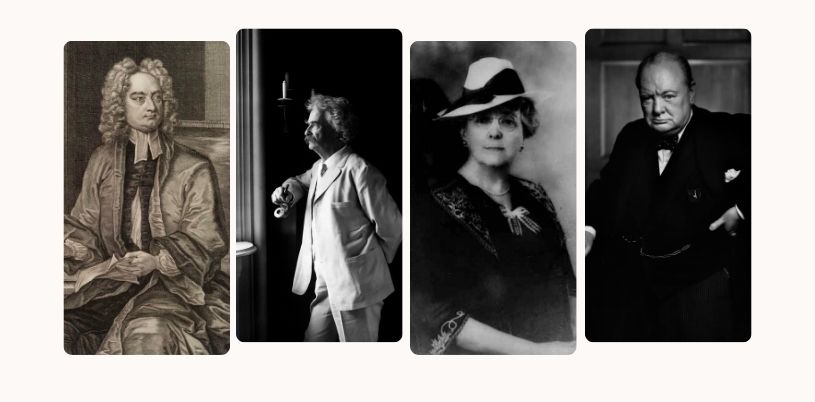
Jonathan Swift,
b. November 30, 1667, d. October 19, 1745
Books, the children of the brain.
A Tale of a Tub and Other Writings (1704)
Irish satirist and clergyman. Swift grew up under the care of his uncle and received a Bachelor’s degree from Trinity College. He was the dean of St. Patrick’s Cathedral in Dublin. Most of his work was published under pseudonyms. He is best known for Gulliver’s Travels (1726), originally published anonymously, under the name Lemuel Gulliver, the novel’s the protagonist and narrator. Any messages or letters and corrections related to the text were communicated through friends and as such, even though his close friends like Alexander Pope knew about the publication, Swift still feigned ignorance about the book in his correspondence with them.
*****
Samuel Langhorne Clemens, pen name Mark Twain,
b. November 30, 1835, d. April 21, 1910
Something to know, if you don’t already, is that Mark Twain is liberally misquoted. Much like Albert Einstein, words are often falsely attributed to him that he mayn’t even thought about, let alone ever said. This one is authentic Twain:
When angry, count four; when very angry, swear.
Pudd’nhead Wilson (1894)
American writer, humorist, journalist, essayist, entrepreneur, publisher, and lecturer. The pen name was adopted in 1863 when he was a newspaperman in Nevada, though it refers to the days when he worked on a steamboat and a crewman would call ‘mark twain’, which is a measure of the depth of the water and means two fathoms, or 12 feet. Clemens was born prematurely, a frail infant and sickly child, not expected to live. The Clemens family had 19 cats at one time during Twain’s childhood. He gave his cats names like Bambino, Famine, Pestilence, Satan, Sin, Sour Mash, and Stray Kit. In 1874, he bought one of the first typewriters, a Remington. I read it could only type capital letters and the carriage return had to operated with a foot pedal. Twain also claimed to be the first person in New England to have had a telephone for private use. He was 5 feet 8 1/2 inches tall. He often wore all white suits and scarlet socks. He called them his ‘don’tcareadam suits’. Twain liked to write in bed and there were several reporters who interviewed him there more than once. Halley’s Comet, perhaps the most famous comet in history, is a ‘periodic’ comet and returns to Earth’s vicinity about every 75 years, which means that a person can see it twice in their lifetime. It was last here in 1986 and is projected to return in 2061. Anyway, decades ago, I read that Mr. Twain had arrived in 1835, a year of Halley’s Comet. 1910 was also a Comet year and he died one day after the Comet had reached its perihelion.
*****
L. M. Montgomery, in full Lucy Maud Montgomery OBE,
b. November 30, 1874, d. 24 April 1942
Marilla, isn’t it nice to think that tomorrow is a new day with no mistakes in it yet?
Anne of Green Gables (1908)
Lucy Maud Montgomery OBE is arguably Canada’s most widely read or if not, one of our longest read author. Anne of Green Gables, her first novel, was an immediate success and has remained in print for well over a century. Anne Shirley is indeed, an icon of Canadian culture. Montgomery wrote more than 500 short stories, 21 novels, 2 poetry collections (500 poems), and many journal and essay anthologies. Her body of work has sold an estimated 50 million copies worldwide. Anne of Green Gables alone has been translated into at least 36 languages as well as Braille and has been adapted for stage, film, radio and television. Montgomery was named an Officer of both the Order of the British Empire and the Literary and Artistic Institute of France. She was the first Canadian woman to be made a member of the British Royal Society of Arts and was declared a Person of National Historic Significance in Canada.
It was never Montgomery’s intention to be as well known as she became, though she was always determined to have her work published. Indeed, the success with which she was met never settled comfortably with her. It cloaked her like a a piece of clothing that didn’t sit or fit quite right. That said, her need to write, to weave her stories, the fictitious, as well as the real anecdotes from her own life, were far greater, more driven, than any unease or awkwardness she may have felt from the public attention she was afforded by the publication of her novels.
*****
Winston Churchill, in full Sir Winston Leonard Spencer Churchill,
b. November 30, 1874, d. January 24, 1965
This is the lesson: never give in, never give in, never, never, never, never—in nothing, great or small, large or petty—never give in except to convictions of honour and good sense. Never yield to force; never yield to the apparently overwhelming might of the enemy.
Speech, Harrow School, October 29, 1941
British historian, politician, writer, artist and a man with a wicked wit. He was Prime Minister of the United Kingdom for most of the Second World War, and again from 1951 to 1955. In 1953, he was awarded the Nobel Prize in Literature ‘for his mastery of historical and biographical description as well as for brilliant oratory in defending exalted human values’. His works include a history of the First World War in 6 volumes under the title of The World Crisis (1923-1931); The Second World War, his memoirs of World War II, were published in 6 volumes between 1948 and 1953; and A History of the English-Speaking Peoples in 4 volumes was published between 1956 and 1958. His oratory survives in a dozen volumes of speeches, among them The Unrelenting Struggle (1942), The Dawn of Liberation (1945), and Victory (1946).
One interesting bit I read about was his dialogues with Lady Nancy Astor, in full, Nancy Witcher Langhorne Astor, Viscountess Astor, CH (b. May 19, 1879, d. May 2, 1964) who was, while American born, a British politician and the first woman seated as a Member of Parliament (MP). A member of the Unionist Party (now the Conservative Party), she served from 1919 to 1945. She wed (her second marriage) American born Englishman Waldorf Astor in 1906.
Churchill was Secretary of State for War when Astor first became an MP. He knew her and had been a guest of hers and her husband’s at Cliveden, the estate where they lived in Buckinghamshire on the River Thames. Regardless, he resented her presence in Parliament and over the years, the hostility between them became clear. In the Commons, he blatantly ignored and criticized her. She in turn, would heckle his speeches and, when asked what she thought of him, said she felt that ‘his prejudices were strong’. While noted for her exchanges with Churchill, these are not well documented. Here are 3, just for chuckles:
Churchill: I find a woman’s intrusion into the House of Commons as embarrassing as if she burst into my bathroom when I had nothing to defend myself with, not even a sponge.
Lady Astor: You are not handsome enough to have worries of that kind.
I read that she is said to have responded to Churchill when he asked about what costume he should wear to a masquerade ball with: ‘Why don’t you come sober, Prime Minister?
Another recounted exchange, likely the best known, was when Lady Astor said to Churchill, ‘If you were my husband, I’d poison your tea’, to which he responded, ‘Madam, if you were my wife, I’d drink it!’
The one piece of common ground that I found between them was was an admiration of T. E. Lawrence (Lawrence of Arabia). A great friend of Lady Astor’s, Lawrence could just as well have been Churchill’s crony, had he chosen to go into politics. I read that at Lawrence’s funeral in May 1935, despite their mutual acrimony, the two held hands and wept together.
Photo credits:
Paul Fourdrinier (Pierre), after Charles Jervas;
Jonathan Swift (circa 1718)
Library of Congress / Public Domain: Mark Twain (1907)
L. M. Montgomery, Library and Archives Canada (date unknown)
Yousuf Karsh; Winston Churchill (1941)
The story behind this photograph is that Karsh saw that Churchill’s cigar was ever present, so he held out an ashtray, but Churchill would not get rid of it. Karsh went back to his camera, checked that everything was all right technically and waited. Churchill continued to chomp down vigorously at his cigar. Karsh waited. Then he stepped toward him and ever so respectfully, said, ‘Forgive me, sir,’ and pulled the cigar out of his mouth. When Karsh got back to his camera, Churchill looked hostile enough to have devoured him. In that moment, this photo was snapped.
We make every effort to be accurate and fair-minded with the information posted.
If you see something that doesn’t look right, or if you are interested in any of the books associated with our posts, please contact us directly at http://spaffordbooks.ca/ , through Messenger, or phone 306.525.4910. If the book you want is not in stock, copies may be brought in for you.
Please, buy local. Thank you.