
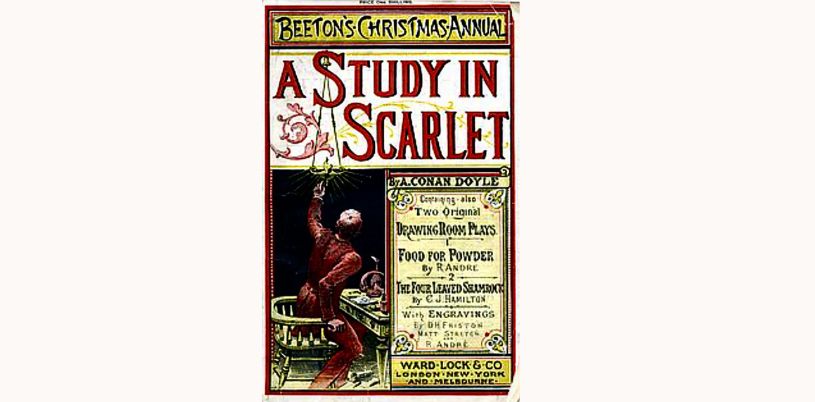
December 1, 1887
Sherlock Holmes makes his first appearance in print in ‘A Study in Scarlet’.
or did he?
There are a various Internet sites that say that Beeton’s Christmas Annual, which first published A Study in Scarlet, printed the story on December 1, 1887.
It would make sense that a Christmas Annual would be available, or at least on its way to the newsstand, at the start of December.
However, I rummaged about down the bottom of the rabbit hole as I so often do and have concluded with my research that this is not the case.
There is no exact date to be found on the Annual anywhere and as said, December would be a reasonable guess, but I think it’s always best to check when things are ambiguous.
In ‘A Bibliography of A. Conan Doyle’ (1983) by Richard Lancelyn Green and John Michael Gibson, they state that the Annual was issued in November 1887.
In an effort to try to find an exact publication date, a search of British newspapers dated November 1887 to look for adverts seemed a sensible thing to do. The first one looked at is in ‘The Standard’, issued November 21, 1887, which identifies that the Beeton’s Christmas Annual is ‘Just Ready, in Picture Covers. One Shilling’. The same advertisement is seen in the newspaper several times that week, and is also seen in other newspapers, like ‘The Daily News’ (November 22); ‘The Yorkshire Post’ (November 23) and ‘The Glasgow Herald’ (November 24). There was no Amazon back then (those were the days), which is to say that the publisher, Ward, Lock, and Co., would not have advertised if the publication was not yet for sale.
In 1887, November 21 was a Monday, and there had been no adverts for the Beeton’s Christmas Annual to be found in The Standard from the previous week. Go back a year and there was an advertisement for the Annual as early as Wednesday, November 17, 1886, and two years prior, in 1885, the advert appeared on Monday, November 16.
I think it is almost certain that the 1887 Beeton’s Christmas Annual was not published on December 1, nor on any other December date. If I was a betting woman, I’d lay odds that it was definitely issued in November, and in all probability, on November 21. I think had it been published the week before, the publisher would have advertised it.
Anyway, all that said and done, Sherlock Holmes first appeared in Conan Doyle’s A Study in Scarlet, published in the Beeton’s Christmas Annual of 1887. As the world’s first and only ‘consulting detective’, Holmes went after criminals throughout Victorian and Edwardian London, the south of England, and continental Europe. Although he had been preceded by C. Auguste Dupin (Edgar Allan Poe) and Monsieur Lecoq (Émile Gaboriau), Holmes made a singular impact upon the popular imagination and, turns out, has been the longest established character of the detective story.
Back to Beeton’s Christmas Annual. This was a paperback magazine published from 1860 (volume 1) through 1898 (volume 39), founded by Samuel Orchart Beeton. In 1872, Beeton had used the Christmas annual to satirize the Royal Family which led to two court cases, one in 1874 and the other in 1875, and forced the sale of his business to his rivals, Ward, Lock & Co. Each issue carried a distinct title that reflected the content for the season. The 1887 edition, was entitled ‘A Study in Scarlet’, though it also contained ‘Food for Powder’ by R. André and ‘The Four-Leaved Shamrock’ by C. J. Hamilton. It was about 8.5″ x 5.5″ and had colour pictorial wrappers (cover), was listed at a price of one shilling, and was sold out before Christmas.
These relatively inexpensive publications were not often preserved by their owners in the way hard bound books were, so many of the periodicals that featured Holmes are now scarce items in high demand. This is especially true of the first 2 Holmes novellas, A Study in Scarlet and The Sign of Four, which appeared as said, in Beeton’s Christmas Annual, and in Lippincott’s Monthly Magazine respectively. Holmes became somewhat lionized a bit later when Arthur Conan Doyle arranged to provide a series of Holmes short stories in The Strand Magazine in 1891.
The 1887 issue of Beeton’s Christmas Annual is what literary aficionados describe as a rarity and as ‘the most expensive magazine in the world’. A copy sold at Sotheby’s for $156,000 in 2007. The illustrations in the Beeton’s Christmas Annual (1887) were done by D. H. Friston (engravings by W.M.R. Quick) for ‘A Study in Scarlet’; by R. André for ‘Food for Powder’ and by Matt Stretch for ‘The Four-Leaved Shamrock’. There was also a frontispiece illustration for A Study in Scarlet.
As mentioned, the Annual was issued as a paperback-style magazine, but of course, they did not know about or use the modern paperback binding process. Some collectors had their copy bound. These bound copies typically contain the literary text of the magazine, but seldom include the original pictorial cover (wrappers), the preliminaries or any back matter advert sections. If bound, the pages were usually trimmed along the edges as part of the binding process.
There are, I read, 34 known extant copies of the 1887 Beeton’s Christmas Annual. Libraries hold 21 of them. The University of Minnesota holds four copies. Yale has three copies and may have previously held another two. All other recorded owners have only single copies. 11 of the 34 copies are complete, which means they include the original wrappers and advertisements; albeit one of these has been bound and another has the spine in facsimile. The other 23 are known to lack the original wrappers and/or advertisements, and some of those have facsimile replacements for the original parts no longer present. There are 2 copies known to be signed by Conan Doyle and a third copy that contained an unsigned inscription by him, but that page was stolen and is considered gone for good.
I read that the manuscript for A Study in Scarlet had met with many rejections from publishers. When Ward, Lock & Co. accepted, they offered £25 for the copyright. Conan Doyle wrote back and asked, logically, for a percentage of the sales. This is the publisher’s answer, dated November 2, 1886:
Dear Sir,
In reply to your letter of yesterday’s date we regret to say that we shall be unable to allow you to retain a percentage on the sale of your work as it might give rise to some confusion. The tale may have to be inserted together with some other in one of our annuals, therefore we must adhere to our original offer of £25 for the complete copyright.
We are, dear Sir,
Yours truly,,
Ward, Lock & Co.
Arthur Conan Doyle, in full Sir Arthur Ignatius Conan Doyle, was born in Scotland on May 22, 1859. In 1868, he started what would become 7 years of Jesuit education in Lancashire, England. After an additional year of school in Feldkirch, Austria, Conan Doyle returned to Edinburgh. Dr. Bryan Charles Waller, his mother’s lodger, had a profound influence upon him and he prepared for entry into the University. He studied medicine at the University of Edinburgh and there he met Dr. Joseph Bell, a teacher with extraordinary deductive powers. Bell, in part and years later, was the inspiration for Sherlock Holmes.
In addition to the dozens of Sherlock Holmes stories and several novels, Conan Doyle also wrote history, pursued whaling, and took part in many adventures and athletic endeavours. He married twice, his first wife died from tuberculosis, the second outlived him and he fathered 5 children. None of the children had children of their own, so there are no living direct descendants.
Arthur Conan Doyle was knighted on October 24, 1902, at Buckingham Place, by King Edward VII, whose coronation, just a month and a bit prior on August 9, had followed the death of his mother, Queen Victoria (January 22,1901). Conan Doyle died of a heart attack at Windlesham Manor, his home in Crowborough, Sussex, on July 7, 1930. He was 71. At the time of his death, there was some controversy with regard to his burial place. He was admittedly not a Christian and considered himself a Spiritualist. He was first buried on July 11, 1930 in his Windlesham rose garden. He was later reinterred with his wife in Minstead churchyard in the New Forest, Hampshire. There are wooden tablets carved in memory of each of them, originally from the church at Minstead, that are on display as part of a Sherlock Holmes exhibition at Portsmouth Museum. The epitaph on his gravestone in the churchyard reads, in part: ‘Steel true/Blade straight/Arthur Conan Doyle/Knight/Patriot, Physician and man of letters’.
A statue to honour Conan Doyle stands at Crowborough Cross in Crowborough, where he lived for 23 years and there is a statue of Sherlock Holmes in Picardy Place, Edinburgh, close to the house where Conan Doyle was born.
The Internet abounds with reputable sites to read more about Conan Doyle and/or his bibliography, should that pique your curiosity. The Toronto Public Library holds a collection of letters from Conan Doyle to his Strand publisher, Herbert Greenhough Smith, that provide many insights into the author’s approach to his work for the magazine, for those interested and/or in Toronto.
We make every effort to be accurate with the information posted. If you see something that doesn’t look right, please let us know through Messenger or at http://spaffordbooks.ca/
Should any of the books associated with our posts prove to be of interest to you, please feel free to contact us, and we will make every effort to put them in your hands. While they may not be in stock, copies may be brought in for you.