
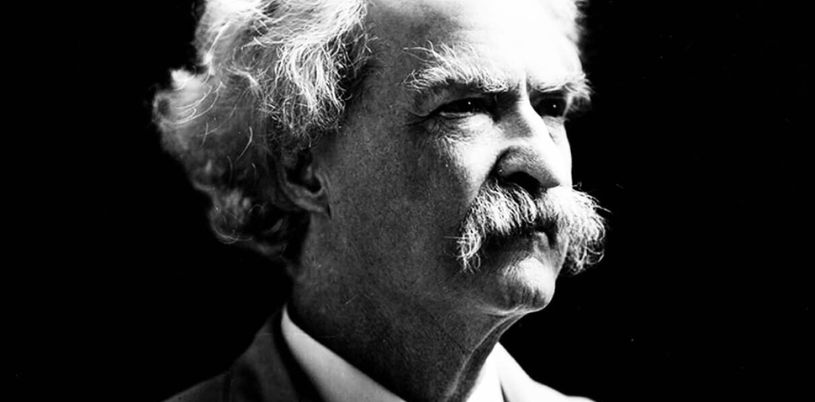
‘Alright then, I’ll go to hell.’
Mark Twain, The Adventures of Huckleberry Finn
Huck has been made to believe it would be sinful to help his friend Jim, who is as you likely know, a runaway slave. In this chapter, Huck finds his personal moral compass and decides to do what he feels is the right thing, albeit that others have told him he would go to hell for it.
A long post today, though that said, please know that it has been whittled down a fair bit from the almost 4,000 words I’d written last night. As always, the bigger the acclaim, and I guess, my interest in what I unearth, the more there is to write. Read what you will and leave the rest.
Mark Twain, pseudonym of Samuel Langhorne Clemens,
b. November 30, 1835, d. April 21, 1910
American humorist, journalist, lecturer, and novelist who acquired international fame for his travel narratives, especially ‘The Innocents Abroad’ (1869), ‘Roughing It’ (1872), and ‘Life on the Mississippi’ (1883), and for his adventure stories of boyhood, especially ‘The Adventures of Tom Sawyer’ (1876) and ‘Adventures of Huckleberry Finn’ (1885). He wrote more than a dozen novels and several short stories as well as essays. Other than his passion to write, I learned that he loved cats. I’d read that at one point, he’d hired 2 cats to keep him company while he wrote, and that when he was a child, his family had 19 cats, all at the same time. He also saw much tragedy, some of which is related here. Regardless, he was a gifted storyteller, funny man, and maybe a tad of a curmudgeon (at least, post Sawyer), he eclipsed the supposed limitations of his origins to become one of the best loved and recognized writers in the American literary canon.
Born 2 months premature on November 30, 1835, in the village of Florida , Missouri, Clemens remained frail until he was 7. He was the 6th of 7 children, only 3 of whom survived to adulthood. In 1839, his father, John Marshall Clemens, a self-educated lawyer who ran a general store, moved his family to Hannibal, also in Missouri, to look for some better business opportunities. He became a justice of the peace there, but had financial struggles. He died at 49 from pneumonia in 1847. Samuel Clemens was 11 years old. ‘The Adventures of Tom Sawyer’ and ‘Adventures of Huckleberry Finn’ are both set in Hannibal.
Clemens loved to play in the water as a child, but never learned how to swim. He was saved from drowning in the Mississippi River 9 times.
When his father died, Clemens dropped out of school to work so he could work and support the family. He spent any free time he had at the public library where he read and self educated, and in the process, learned to see things from a different perspective. Twain valued education and saw it as a vital part of a human growth, though that said, he was critical of the education system in the United States and believed learning and education were two different things.
He went to work as a full time apprentice printer in 1848 for Joseph P. Ament’s Missouri Courier. In 1851, he took a job as a typesetter at The Hannibal Journal, then owned by his older brother, Orion. He eventually penned a handful of short, satirical stories for the publication. In 1853, 17-year-old Clemens left Hannibal and spent the next several years living in New York City, Philadelphia and Keokuk, Iowa, and all the while, worked as a printer.
�Clemens had dreamt of becoming a steamboat pilot, one of the most prestigious jobs at that time, from the time he was a young boy. In 1857, he became an apprentice ‘cub’ steamboat pilot on the Mississippi River. The next year, while he worked on a boat called the Pennsylvania, he got his younger brother, Henry, a job on the same steamboat. Clemens worked on the Pennsylvania until early June. On June 13, 1858, there was a boiler explosion aboard the Pennsylvania and among those who died was Henry, just 19 years old. Clemens was devastated, but pushed through. He trained for 2 years under the experienced Horace Bixby and got his pilot’s license in 1859. He worked on steamboats until the the American Civil War began in 1861 and the commercial traffic along the Mississippi came to an end. His pen name, Mark Twain, or ‘Mark number two’, is a Mississippi River term that means the second mark on the line that measured depth signified two fathoms, or twelve feet. When a leadsman would call ‘by the mark twain’, they would mean the river depth was safe for the steamboat.
Shortly after the Civil War began, in June 1861, Clemens, 25, joined the Marion Rangers, the Confederate militia. Although his family had owned a slave when he was a boy, he never had strong ideological convictions about the war and probably enlisted with the militia primarily out of loyalty to his Southern roots. His time with the group was brief. After 2 weeks of drills, the Marion Rangers, small and under supplied, disbanded when they learned that a Union force led by Ulysses S. Grant was headed their way. Turns out, later in life, Clemens became friends with Grant. He published the former president’s memoir in 1885. The book became a best seller and rescued Grant’s widow from financial hardship after her husband had lost most of their money to bad investments. That story may be accessed through this link, for those interested:
Clemens left Missouri and the war behind and travelled west with his brother Orion, who had been named the territorial secretary of Nevada. Clemens tried his hand at silver mining and when he didn’t strike it rich, took a job as a reporter with ‘The Territorial Enterprise’ newspaper in Virginia City, Nevada, in 1862. His first use of the pseudonym Mark Twain appeared in the Enterprise on February 3, 1863. Prior to that, he had tried other pseudonyms, which included W. Epaminondas Adrastus Blab, Thomas Jefferson Snodgrass, and Sergeant Fathom.
In May 1864, Twain challenged a rival Nevada newspaperman to a duel after they’d had some disagreement. Twain left before the actual fight took place; I’d read because he wanted to avoid arrest for violation of the territory’s ‘anti dueling’ law.
He headed to San Francisco where he got a job as a reporter, but soon grew disillusioned with the work (he wrote about crime, politics, mining and culture) and was subsequently fired. Later that year, he posted bail for a friend who’d been arrested in a barroom brawl. Perhaps predictably, the friend skipped town, and Twain, who didn’t have the funds to cover the bond, decided to leave San Francisco as well. He travelled to the cabin of friends at Jackass Hill in Tuolumne County, California. The Jackass Hill area had boomed at the time of the gold rush in 1849, but when Twain went, there were only a few miners left there. He heard a man tell a tale about a jumping frog contest when he was at a bar in the nearby town of Angels Camp in Calaveras County, California. When he went back to San Francisco in February 1865, he received a letter from a friend, a writer in New York, who asked him to contribute a story for a book he was putting together. Twain decided to send his story based on the jumping frog tale he’d heard, but by the time he finished it, the book had already been published. The book’s publisher sent the piece, then called ‘Jim Smiley and His Jumping Frog’, to the New York Saturday Press in New York. They ran the story on November 18, 1865. It was a huge hit with the readers and was reprinted across the country, later retitled ‘The Celebrated Jumping Frog of Calaveras County’. Its success further paved the way for a new opportunity at the Sacramento Union and Twain was sent on assignment to Hawaii to write a series of travelogues. Today, now one of the longest running fairs in California, is held in historic downtown Angels Camp. There is 4 day event, the international The Calaveras County Fair and Jumping Frog Jubilee, held the 3rd weekend in May each year (Thursday through Sunday) to commemorate the story that launched Mark Twain’s career.
In 1870, Clemens married Olivia Langdon. She had been raised in an abolitionist family in Elmira, New York. They were introduced by Olivia’s younger brother, who had met Clemens on a voyage to Europe and the Holy Land, when they were aboard the steamship ‘Quaker City’ in 1867. Clemens had written about this trip in his travel book, ‘The Innocents Abroad’ (1869). The Clemenses had four children; a son who died as a toddler and two daughters who died in their 20s. Olivia Clemens died in 1904. She was 58. Samuel Clemens (Twain) died at his home in Redding, Connecticut on April 21, 1910. The only child that remained, Clara, died at 88 in 1962. Clara Clemens had one child, Nina Gabrilowitsch, who was childless, died in 1966. There are no direct descendants of Samuel Clemens alive today.
‘Adventures of Huckleberry Finn’ (1885)is, I know you know, is the story of a young misfit who floats down the Mississippi River on a raft with Jim, a runaway slave. Huck Finn was first seen ‘The Adventures of Tom Sawyer’ (1876) as Sawyer’s sidekick. Huck was based on Tom Blankenship, a boy 4 years older than Twain, and with whom he had grown up in Hannibal. Blankenship’s family was poor and his father, a labourer, had a reputation as the town drunk. Twain said, in his autobiography, ‘In Huckleberry Finn I have drawn Tom Blankenship exactly as he was. He was ignorant, unwashed, insufficiently fed; but he had as good a heart as ever any boy had’. No one knows what happened to Blankenship later in life. Twain said he’d heard a rumour Blankenship became a justice of the peace in Montana, and other sources cite that he was jailed for theft or died of cholera. It took Twain 7 years to complete the Adventures of Huckleberry Finn. He had started to write it in 1876, but was unhappy with its progress. He picked it up again and finished its authorship in 1883. What we do know for certain is that from the time of its publication, ‘ Adventures of Huckleberry Finn’ has been controversial. A month after its release, it was banned by the public library in Concord, Massachusetts, for its coarse language and low moral tone. In the mid 20th century, critics condemned the book as racist and eventually, it was removed from some school reading lists. Many scholars, with whom I agree, contend the book is a criticism of racism.
After he became a successful writer, Twain made some poor decisions; he sank money into a number of bad investments and after a time, he went bankrupt. One of his investments, a fiasco, involved an automatic typesetting machine, which cost him nearly $200,000 by most estimates. It was an enormous sum in 1890 when the average American family earned less than $1,200 a year. Regrettably, when he was offered the opportunity to invest in the telephone, by all reports, he turned down its creator, Alexander Graham Bell. Twain invented a number of products himself, which included a self-pasting scrapbook, which sold well, and an elastic strap for pants, which did not.
A staunch supporter of technological progress and commerce, I learned in what was not my favourite discovery, that Twain was against welfare measures; he believed that society in the business age is governed by exact and constant laws that should not be interfered with for the accommodation of any individual or political or religious faction. He was more conservative than liberal and thought personal political rights were secondary to those of property and advocated for a leadership composed of wealthy men with brains. Then I read ‘Life on the Mississippi’ (1883) that talks about unions in the river boating industry and which was read in union halls decades later. He supported the labour movement, which included one of the important unions of the time, the Knights of Labor, and I thought that was cool. As an aside, Life on the Mississippi was the first book submitted to a publisher as a typewritten manuscript In fairness, Twain did not type it himself. His secretary, Isabel V. Lyon, typed from Twain’s manuscript.
In 1891, Twain closed up his Hartford home where he had lived since 1874 to relocate with his family in Europe, where he thought they could live more cost effectively, though he also hoped the change of scenery would help his wife, who was in poor health. In 1894, after the publishing company he had founded a decade earlier fell flat, Twain declared bankruptcy. The next year, he went on a lecture tour around the world in the concerted effort to earn money to pay off his debts. All creditors were paid in full within a few years.
Soon after his return from Europe in 1901, until his death in 1910, Twain was vice-president of the American Anti-Imperialist League and wrote many political pamphlets for the organization. The League stood opposed the annexation of the Philippines by the United States and had tens of thousands of members. The Incident in the Philippines, published posthumously in 1924, was his response to the Moro Crater Massacre, in which 600 Moros were killed. Many of his neglected and previously uncollected works on anti-imperialism appeared for the first time in book form as ‘Mark Twain’s Weapons of Satire: Anti-imperialist Writings on the Philippine-American War (Studies on Peace & Conflict Resolution)’, edited by Jim Zwick (1992). Twain was also critical of imperialism in other countries. In ‘Following the Equator: A Journey Around the World’ (1897), Twain expresses hatred and condemnation of imperialism of all stripes. He was very critical of European imperialists such as Cecil Rhodes and King Leopold II of Belgium, both of whom attempted to establish colonies on the African continent during the Scramble for Africa.
King Leopold’s Soliloquy (1905) is a political satire pamphlet about his private colony, the Congo Free State. There are documented reports of his outrageous exploitation and grotesque abuses which led to an international outcry in the early 1900s, arguably the first large scale human rights movement. In the soliloquy, the King contends that to bring Christianity to the colony would outweigh a little starvation. The abuses against Congolese labourers continued until the movement forced the Belgian government to take direct control of the colony in 1908. It was renamed the Belgian Congo and remained so until the Democratic Republic of Congo gained its independence in 1960.
Twain wrote a short pacifist story, ‘The War Prayer’ at the time of the Philippine – American War. It argues that humanism and the Christian narrative of love are not compatible with the conduct of war. Submitted to Harper’s Bazaar for publication, the magazine rejected the story as ‘not quite suited to a woman’s magazine’ on March 22, 1905. He had an exclusive contract with Harper & Brothers and so could not publish The War Prayer elsewhere. It remained unpublished until 1916. None but the dead are permitted to tell the truth. It was republished in the 1960s as campaign material by anti-war (Vietnam) activists.
He was born two weeks after the closest approach of Halley’s Comet in 1835. In 1909 he said: “I came in with Halley’s Comet in 1835. It is coming again next year, and I expect to go out with it. It will be the greatest disappointment of my life if I don’t go out with Halley’s Comet. The Almighty has said, no doubt: ‘Now here are these two unaccountable freaks; they came in together, they must go out together’.” An eerily accurate prediction as Twain died of a heart attack on April 21, 1910, in Stormfield, his mansion in Connecticut that he’d built and lived in since 1908, one day after the comet’s closest approach to Earth.
His funeral was at the Brick Presbyterian Church on Fifth Avenue, New York. He is buried in his wife’s family plot at Woodlawn Cemetery in Elmira, New York. The Langdon family plot is marked by a 12-foot monument (two fathoms, or ‘mark twain’) that was placed there by his daughter Clara. His is also a smaller headstone. Twain’s preference was for cremation (as he said in Life on the Mississippi and at other times), but he acknowledged that whoever survived him (Clara) in his family would have the last word.
This link will provide you with the inconvenient, lesser discussed truths about Mark Twain, should you feel so inclined:
Photo credit:
A.F. Bradley; Mark Twain (1907)
Montreal Gazette / Library of Congress
We make every effort to be accurate with the information posted. If you see something that doesn’t look right, please let us know through Messenger or at http://spaffordbooks.ca/
Should any of the books associated with our posts prove to be of interest to you, please feel free to contact us, and we will make every effort to put them in your hands. While they may not be in stock, copies may be brought in for you.