
‘If we cross the Irwell to Salford, we find. . . one large working men’s quarter, penetrated by a single wide avenue. . . All Salford is built in courts or narrow lanes, so narrow, that they remind me of the narrowest I have ever seen, the little lanes of Genoa. . . The working men’s dwellings between Oldfield Road and Cross Lane. . . vie with the dwellings of the Old Town in filth and overcrowding.
In this district I found a man, apparently about 60 years old, living in a cow stable. . . which had neither windows, floor, nor ceiling. . . and lived there, though the rain dripped through his rotten roof. This man was too old and weak for regular work, and supported himself by removing manure with a hand-cart; the dung heaps lay next door to his palace.
The working people live, almost all of them, in wretched, damp, filthy cottages. . . the streets which surround them are usually in the most miserable and filthy condition, laid out without the slightest reference to ventilation, with reference solely to the profit secured by the contractor . . .’
Friedrich Engels, The Condition of the Working Class in England (written 1844-1845, published 1845).
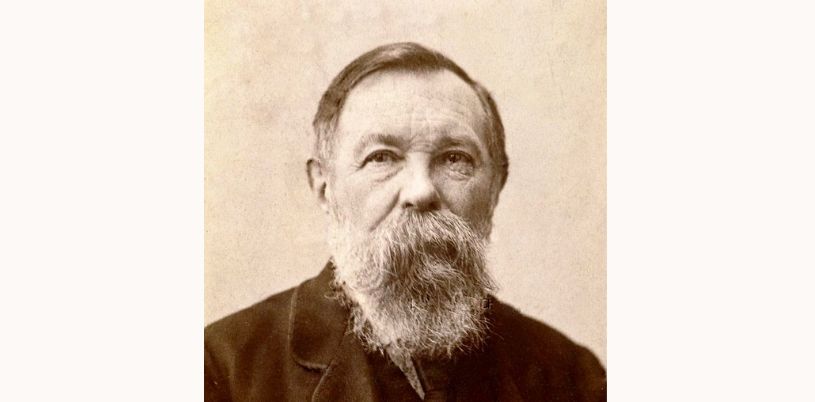
Friedrich Engels, also spelled in English as ‘Frederick’ Engels,
b. November 28, 1820, d. August 5, 1895
German socialist philosopher, historian, journalist, political theorist, revolutionary socialist, and a businessman, Engels was a lifelong friend of Karl Marx. Together they laid the foundation for modern communism and the political-economic theory known as Marxism, the ideas of which are centred on the class struggle between the bourgeoisie and the proletariat and the inherent belief that capitalism would eventually collapse and move the world to communism. The quote (above) is based on his personal observations and research done in Manchester, England.
He and Marx published their well known work, ‘The Communist Manifesto’ in 1848. They also co-authored The Holy Family (1844) and The German Ideology (1846). Engels supported Marx financially to do research and write Das Kapital. After Marx died in 1883, he destroyed over 1500 letters between himself and Marx, so as not to expose their ideologies. Engels edited the second and third volumes of Das Kapital (1885, 1894) with much personal surrender and is credited, I read, with having salvaged the work from Marx’s ‘incredibly difficult handwriting’.
Engels also wrote The Peasant War in Germany (1850); Herr Eugen Dühring’s Revolution in Science, popularly known as Anti-Dühring (1878), Socialism: Utopian and Scientific (1880);
Dialectics of Nature, unfinished, (1878–1882), The Origin of the Family, Private Property and the State (1884), and Ludwig Feuerbach and the End of Classical German Philosophy (1886).
A polyglot, Engels was able to write and speak in Russian, Italian, Portuguese, Irish, Spanish, Polish, French, English, German and the Milanese dialect.
Friedrich Engels died of throat cancer in London, on August 5, 1895. He was 74. He was cremated at Woking Crematorium in West Surrey and his ashes were scattered off Beachy Head, near Eastbourne, as per his request. He left a considerable estate to Eduard Bernstein and Louise Freyberger (the wife of Ludwig Freyberger), valued at the time for probate at £25,265, worth around £2,807,358.30 today (My search at the Bank of England told me this, though please allow for marginal error on my part).
An obituary,‘Frederick Engels’, a true appreciation of the General, was written by V.I. Lenin (Vladimir Ilyich Ulyanov). It begins with the words: ‘What a torch of reason ceased to burn, What a heart has ceased to beat!’. The tribute was published in Rabotnik in early 1906, but was not first fully translated into English until ‘The Communist’ Vol. 14 No. 8. August, 1935, printed for the 40th anniversary of Engels’ death (and hence Friedrich spelled ‘Frederick’).
Photo credit:
Friedrich Engels (1891); artist unknown.
We make every effort to be accurate and fair minded with the information posted.
If you see something that doesn’t look right, or if you are interested in any of the books associated with our posts, please contact us directly at http://spaffordbooks.ca/, through Messenger, or phone 306.525.4910. If the book you want is not in stock, copies may be brought in for you. Please, and I cannot stress this enough, buy local. Thank you.